
Apply Mechanical Design Principles for Code Quality
Apply mechanical design principles to software for stronger, more reliable, and predictable code that scales

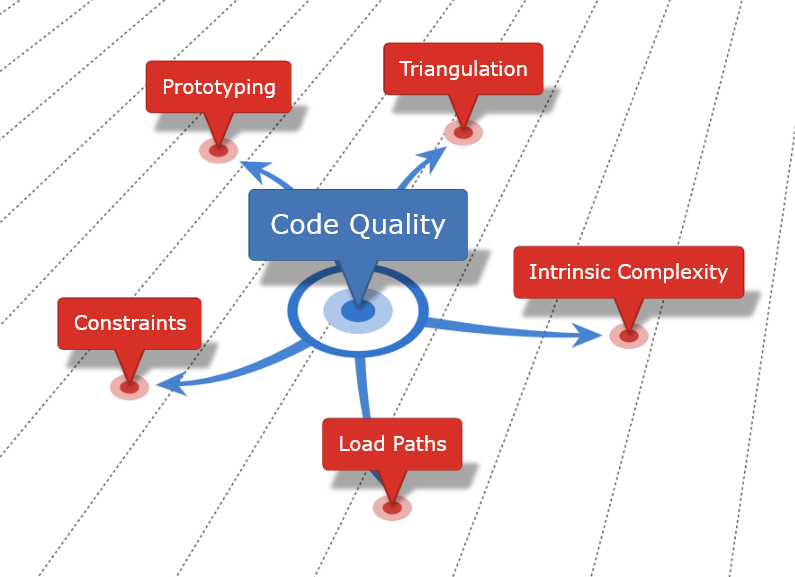
In the world of engineering, stability, clarity, and predictability are essential to creating systems that endure. These principles are not exclusive to physical systems; software engineering can equally benefit from a structured, mechanically inspired approach. Just as a well-designed machine is clear and resilient, high-quality code should be simple, modular, and adaptable. Here, we explore how core principles from The Elements of Mechanical Design by James G. Skakoon can enhance code quality, bringing integrity, simplicity, and stability to software engineering.
Readable Code: Simplicity and Independence
Readable code is the foundation of code quality. By keeping complexity hidden within, we can make interactions straightforward and ensure that different parts of the codebase remain clear and easy to understand.
Element 1: Create Designs That Are Explicitly Simple—Keep Complexity Intrinsic
In mechanical design, simplicity allows ease of understanding and usability, with complexity residing in its purpose. Software follows the same principle—complex logic should be encapsulated in well-defined, easy-to-understand functions or modules while that complexity resides within the problem that is being solved with software.
Write code that is easy to follow by using clear naming conventions, modular designs, and simple control structures. Comments should explain why decisions were made, rather than what the code does.
Instead of writing a large function with intricate internal logic, break it down into smaller, purpose-driven functions. These functions hide complexity, enabling other developers to use them without being concerned with every detail.
Encapsulate complexity within manageable modules to improve readability and maintain simplicity at the interface level.
Element 2: Keep the Functions of a Design Independent from One Another
Mechanical designs benefit from independent components that do not interfere with one another. In software, this means following the Single Responsibility Principle, which keeps different functionalities separate and allows each part to remain understandable on its own.
Use functions or methods that serve a single purpose to maintain clear separation of concerns, reducing dependencies and enhancing readability.
A user authentication module should not directly handle database logic but should use a separate service for data interactions. This approach keeps responsibilities distinct, making each component easier to read and maintain.
Maintain code independence by adhering to single-purpose modules, which supports readability and modularity.
Stable Code Structures: Robust and Resilient
Stable code withstands change and scale effectively. By borrowing structural principles from mechanical design, we can create resilient software that accommodates growth without compromising integrity.
Element 5: Triangulate Parts and Structures to Make Them Stiffer
Triangulation provides stability and rigidity in mechanical structures. In software, we achieve similar stability by using design patterns and architectural frameworks that support structured, scalable growth.
Apply proven design patterns (e.g., Model-View-Controller, Dependency Injection, or Factory patterns) to establish a robust framework, enabling flexibility as the codebase evolves.
Using an Observer pattern allows a system to scale smoothly as more observers (or listeners) are added, preventing core logic from becoming tangled or fragile.
Use design patterns to strengthen code structures, aiding stability as the system expands.
Element 6: Avoid Bending Stresses—Prefer Tension and Compression
Mechanical designs prefer tension and compression over bending to enhance stability. In software, this translates to avoiding convoluted, fragile code structures, opting instead for clear constructs that accommodate change smoothly.
Write code that’s easy to extend without creating dependencies. Favor modular structures that remain resilient to changes.
Avoid tightly coupled code where changes in one module require cascading updates across the system. Instead, use interfaces or abstract classes to define clear boundaries, allowing individual modules to evolve independently.
Prevent fragile code by minimizing dependencies and favoring modular structures.
Predictable Behaviors: Planning and Testing for Consistency
Predictability is crucial for system reliability. Software that behaves consistently requires planning, testing, and careful management of data flows.
Element 4: Plan the Load Path in Parts, Structures, and Assemblies
Mechanical design considers how loads transfer through components to ensure stability. In software, planning how data flows and control logic functions create predictable, consistent behavior.
Design data and control flows early in the development process. Well-defined flows yield consistent results across different parts of the application.
Define a clear request flow in a web application (from the controller to the service to the data access), where each area performs a predictable role.
Plan data flow early to ensure predictability and consistency across the system.
Element 14: Analyze and Test for Trends and Relationships
Mechanical engineers analyze component interactions to ensure reliability. In software, this principle translates to testing code extensively to ensure consistency across various conditions.
Use unit tests, integration tests, and continuous monitoring to analyze interactions across system components. Monitoring trends in test results can highlight areas prone to inconsistent behavior.
Write comprehensive test cases covering edge cases and expected behaviors to ensure that code consistently produces correct results under different inputs.
Regularly test and analyze code to maintain predictable behavior across the application.
Refactoring: Iteratively Improving Code
Iterative improvement is key to maintaining high code quality. Regularly refining and restructuring code helps keep it manageable and efficient over time.
Element 11: Build Prototypes of Everything—But Not All at Once
Prototyping enables mechanical engineers to experiment and refine designs. In software, refactoring serves a similar purpose by iteratively improving the internal structure without altering externally observable behavior.
Regularly refactor code to enhance maintainability while preserving functionality.
Break down large functions into smaller, modular ones. Each refactoring step improves testability and maintainability while providing the same external functionality.
Continuous refactoring refines and strengthens the codebase over time.
Element 10: Invert Geometry to Reveal New Solutions
Inverting geometry in mechanical design often reveals innovative solutions. In software, refactoring offers new ways to optimize performance and maintainability.
Regularly reconsider code structures. Look for opportunities to streamline by exploring different design patterns and approaches.
Replace nested loops with higher-order functions (like map, filter, or reduce) for clarity and performance gains.
Rethink code structures for efficiency and clarity, making room for optimizations.
Code Integrity: Preventing Failures and Ensuring Stability
Code integrity is essential for long-term reliability. By anticipating potential failure points, we can maintain a robust codebase that endures various conditions.
Element 13: Never Overlook Buckling Phenomena in Parts and Structures
Mechanical designs consider potential failure points like buckling. In software, maintaining integrity means proactively addressing security vulnerabilities and performance bottlenecks.
Use static analysis, vulnerability scans, and code reviews to identify potential weaknesses. Anticipate areas where the system might “buckle” under stress.
Prevent security vulnerabilities such as SQL injection by implementing input validation and parameterized queries, keeping the system stable even under malicious input.
Proactively address weak points to maintain system integrity under stress.
Element 3: Use Exact Constraint When Designing Structures and Mechanisms—Never Overconstrain a Design
Applying the right level of constraint in mechanical design prevents unwanted movement. In software, constraints (like input validation and type safety) ensure stability without overly restricting flexibility.
Implement constraints that enforce correct behavior but avoid overly restrictive conditions. For instance, use clear type definitions or input validation but allow flexibility where it’s safe.
Use interfaces to set boundaries for acceptable input and output, while avoiding hardcoded dependencies that might restrict future enhancements.
Apply constraints that ensure stability while preserving adaptability.
Code Quality Through Mechanical Design Principles
The principles of mechanical design—simplicity, independence, stability, predictability, and controlled constraint—are equally valuable in software engineering. By applying these principles to code, software engineers can create systems that are readable, maintainable, and resilient. Like mechanical engineers who continuously refine prototypes, software developers should embrace practices like refactoring, testing, and careful planning to build quality systems that stand the test of time.